
PBM 101

SmithRx
Key Takeaways
Legacy PBM contracts can use spread pricing and retained rebates that obscure a plan's true net cost.
Even if a PBM labels itself as pass-through, employers should verify which rebates and discounts reach the plan.
Modern PBMs pair true transparency and client-aligned incentives with accessible data and clinical execution.
Originally Published: July 17, 2024 | Updated: November 6, 2026
The pharmaceutical industry is experiencing a revolution, with pharmacy benefit managers (PBMs) at its epicenter. Plan sponsors and employers are no longer accepting opaque, legacy PBM practices as status quo. In Business Group on Health's 2026 Employer Health Care Strategy Survey of 121 large employers, 41% were changing PBMs or conducting a PBM request for proposal (RFP).
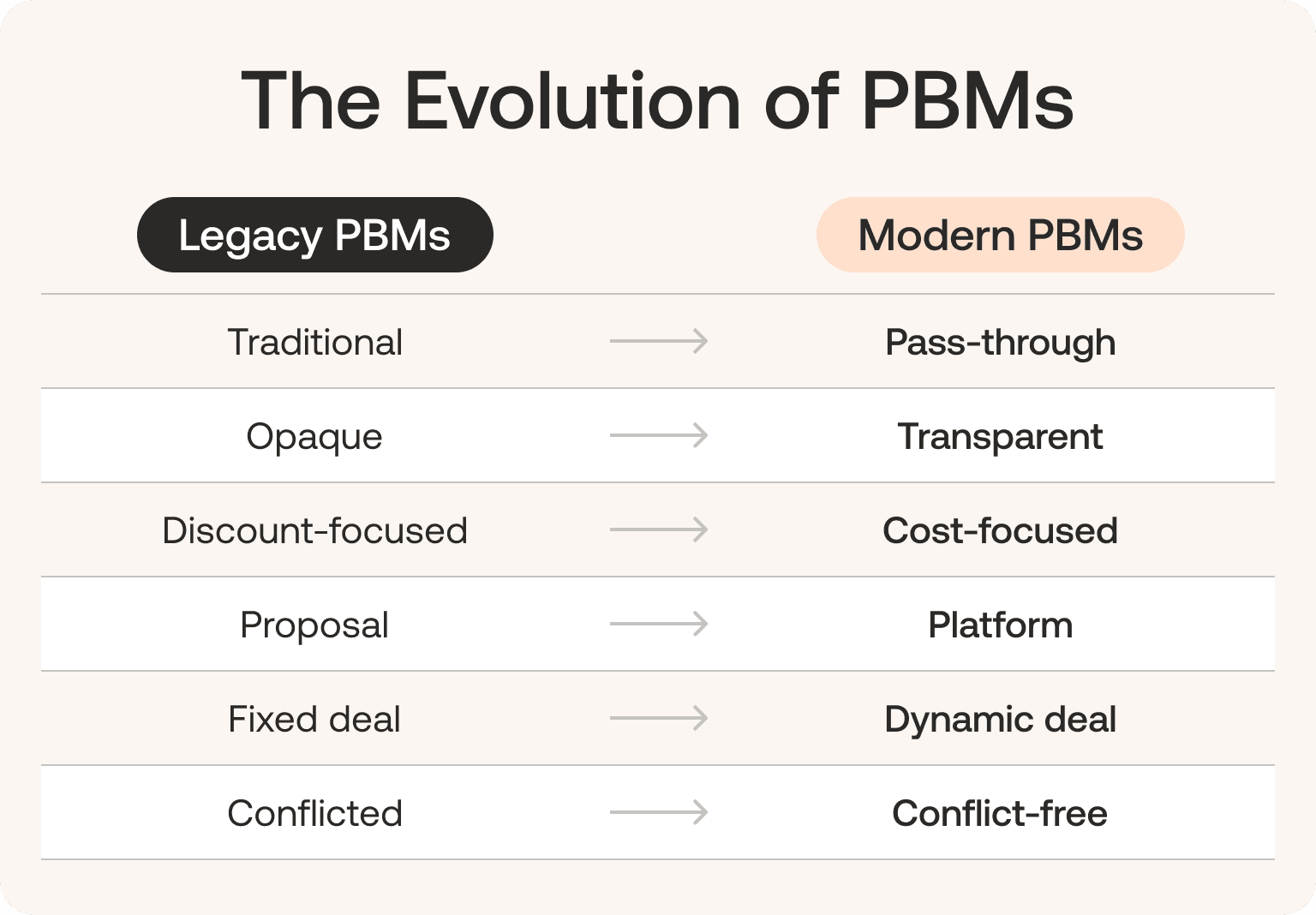
Employers evaluating a PBM now weigh how it is paid, where manufacturer rebates go, and what data the plan can see alongside the discounts in the proposal. Those considerations separate legacy PBMs, often also called traditional PBMs, from modern PBMs. Both terms describe PBM business and operating models, and the differences show up in contract structure, compensation incentives, data access, and clinical execution, each with direct consequences for plan cost and PBM selection.
Let's explore the six key areas where this evolution is most evident and critical.
1. Traditional vs. Pass-Through Pricing
One of the most significant transformations is the evolution of pricing models. This change reflects a broader alignment of interests between PBMs and their clients.
Legacy PBMs: Traditionally, PBMs have operated on a complex system that often prioritizes their own profitability over client savings. Many use spread pricing, a contract practice in which the PBM charges the plan more for a prescription than it reimburses the pharmacy and keeps the difference. Additionally, these PBMs typically retain a portion of manufacturer rebates, often without full disclosure to clients.
Their revenue streams are further complicated by various hidden fees, which obscure the true cost of services. This lack of transparency makes it challenging for clients to understand and control their pharmacy benefit costs.
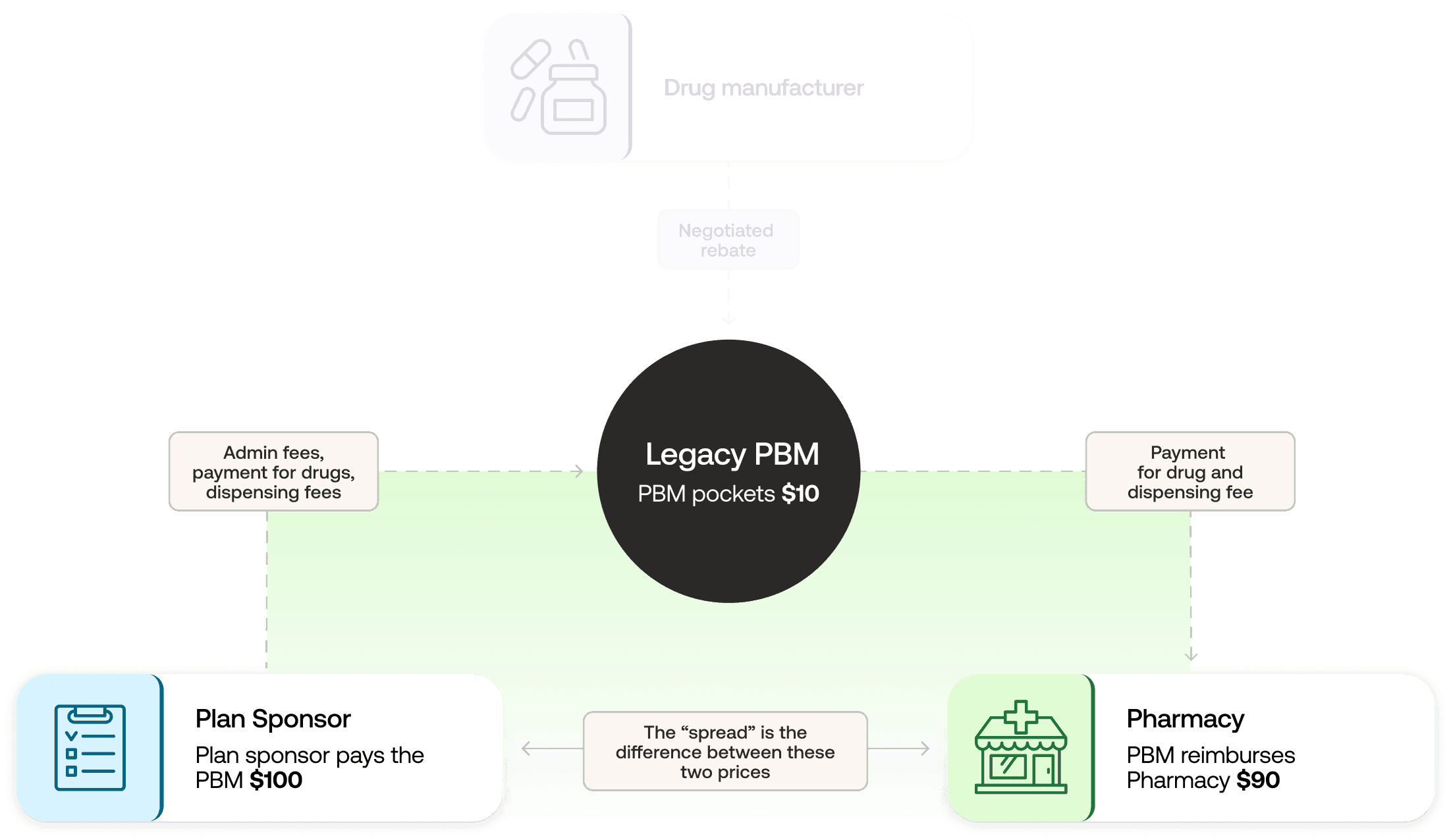
Modern PBMs: In contrast, modern pass-through PBMs have adopted a radically different approach. These PBMs pass all pharmacy costs directly to clients without markup, ensuring that clients pay exactly what the PBM pays for medications. They also pass 100% of manufacturer rebates to clients, which removes rebate size as a factor in the PBM's own compensation. Their revenue comes from clearly disclosed administrative fees.
This transparent model allows clients to see exactly where every dollar is spent, fostering trust and enabling more effective cost management. Pass-through describes a contract feature, though, so employers should confirm exactly which rebates and discounts reach the plan before treating a contract as fully aligned.
2. Opaque vs. Transparent
Transparency has become a regulatory expectation for many employer plans. In October 2026, the U.S. Department of Labor issued a final rule on PBM fee disclosure covering fiduciaries of large self-insured ERISA plans. It requires PBMs to disclose direct and indirect compensation, including retained rebates and spread compensation.
Legacy PBMs: Historically, PBMs have been criticized for their lack of transparency. Complex contracts, hidden fees, and unclear pricing structures have made it difficult for clients to understand true costs.
Modern PBMs: Transparency is a cornerstone of modern PBM practices. They provide clear, detailed reporting on all aspects of drug spend. This openness allows clients to make informed decisions and hold their PBM accountable.
3. Discount-Focused vs. Cost-Focused
When it comes to drug pricing, what you see isn't always what you get. As PBMs evolve, they're challenging long-standing practices in pharmaceutical cost management.
Legacy PBMs: Discount-focused strategies rely heavily on inflated list prices. The higher the initial price, the more impressive the discount appears. This structure can reward higher list prices, because a larger "discount" still leaves actual costs high. In this model, a 50% discount on an artificially inflated price may still result in a higher net cost than a 20% discount on a more reasonable baseline price.
Modern PBMs: In contrast, cost-focused PBMs prioritize the bottom line: what clients and patients actually pay. This approach considers the true cost of drugs, factoring in the discounted price along with rebates, administrative fees, and other often-hidden expenses. By focusing on net cost rather than headline-grabbing discount percentages, cost-focused PBMs align their strategies with genuine savings for their clients.
The mutually exclusive nature of these approaches becomes clear in negotiation and formulary management. Discount-focused PBMs might favor drugs with higher list prices and larger discounts, even if the net cost is higher. Cost-focused PBMs, on the other hand, will opt for lower-cost alternatives that might come with smaller nominal discounts but result in lower overall spending.
4. Proposal vs. Platform
Legacy PBM sales cycles revolve around intricate, client-by-client proposals. Modern PBMs are replacing them with clear-cut pricing platforms that offer the same terms, tools, and opportunities to all clients.
Legacy PBMs: These PBMs offer "custom" deals whose terms often benefit the PBM more than the client. Each deal brings complex contracts, hidden costs, and extended negotiation, which makes it hard for employers to compare proposals on equal footing.
Modern PBMs: Modern PBMs offer a single pricing platform for all clients. Every client receives the same terms with no special deals or hidden fees, along with access to the tools and data that put plan sponsors in control.
Travel comparison sites such as Kayak and Expedia illustrate the idea: travelers see prices side by side on the same terms. Platform pricing gives employers a similarly consistent basis for comparing what they pay.
5. Fixed vs. Dynamic Deals
Drug markets shift during a contract term: biosimilars launch, generics enter, and pharmacy reimbursement changes. A deal's structure determines whether the plan or the PBM captures the value of those shifts.
Legacy PBMs: Traditional PBMs typically offer fixed deals characterized by static pricing based on Average Wholesale Price (AWP) discounts and rebate guarantees. These one-size-fits-all approaches don't actively seek out the lowest-cost options and remain inflexible in the face of major market changes. Such standard offerings from discount-based PBMs may not align with client interests and can leave clients vulnerable to market shifts. For instance, the emergence of biosimilars can impact rebate guarantees, or changes in pharmacy reimbursement models can disadvantage clients locked into fixed terms. Perhaps most tellingly, in this structure, when PBMs find ways to reduce supply costs, they often retain the savings rather than passing them on to clients.
Modern PBMs: Modern PBMs are embracing a more adaptive approach with dynamic deals. In this model, PBMs continuously scan the market for improved cost pathways. When a lower-cost option is identified, they swiftly act to drive volume through these channels. The key differentiator is that the cost benefits of these lower-cost pathways immediately flow through to the client.
This approach lets the PBM and the client adjust as the pharmaceutical market shifts. Because lower-cost pathways flow through to the plan, it also aligns PBM incentives with client interests. By embracing flexibility and continuous optimization, modern PBMs are creating a more responsive, client-centric model that can swiftly navigate ongoing industry changes.
6. From Conflict-Ridden to Conflict-Free
Ownership structure shapes the incentives behind every formulary, channel, and pricing recommendation a PBM makes to an employer.
Legacy PBMs: Traditional PBMs often operate with inherent conflicts of interest. Many own pharmacies or mail-order services, creating a situation where their recommendations and pricing strategies may be influenced by these additional revenue streams. This structure has led to widespread criticism, as it can result in decisions that prioritize the PBM's profitability over client interests. The complex web of ownership and services in legacy PBMs can obscure true motivations and make it challenging for clients to trust that they're receiving unbiased, cost-effective solutions.
Modern PBMs: Today's more forward-thinking PBMs are embracing a conflict-free model. They structure their businesses to eliminate potential conflicts of interest. They don't own pharmacies or have other business interests that could compromise their role as objective advisors and negotiators for their clients. This clear separation allows modern PBMs to focus solely on optimizing pharmacy benefits for their clients without the distraction or influence of other profit centers.
For employers, that separation makes it easier to evaluate whether channel and formulary recommendations serve the plan and its members.
How SmithRx Approaches Modern Pharmacy Benefit Management
Employers leaving a legacy PBM want contract economics, plan data, and clinical decisions they can see and verify. At SmithRx, we combine transparent economics with a fixed per-member-per-month (PMPM) administrative fee and 100% manufacturer rebate pass-through. Because of that structure, our compensation doesn't rise when medication costs do.
As early adopters of these innovative models, our clients are at the forefront of a movement toward more effective healthcare. This transformation goes to the heart of how we manage health benefits, promising significant improvements for all stakeholders. We're committed to transparency, flexibility, and client-centric solutions. If you're interested in learning more about how our innovative approach can benefit your organization, we'd love to hear from you.
Frequently Asked Questions
How does a modern PBM work?
A modern PBM uses transparent contracts, client-aligned incentives, accessible data, and coordinated clinical and operational execution to improve plan and member outcomes. That model lets employers see how the PBM is paid and how prescription drug dollars flow through the plan.
What should employers ask when switching from a legacy PBM to a modern PBM?
Employers should ask how the PBM is compensated, which rebates and discounts pass through, and what data and audit rights the plan receives. They should also ask whether ownership relationships affect formulary or channel decisions and how clinical programs are executed.
Does federal PBM reform make every PBM transparent?
Not on its own, because the Department of Labor's final rule centers on compensation disclosure and plan audit rights for large self-insured plans. Employers still need to evaluate how each PBM's contract and compensation work, and our overview of the new federal PBM reform law outlines what to ask.
SmithRx
SmithRx is the #1 Modern PBM, relentlessly focused on eliminating the conflicts and complexity of legacy pharmacy benefits. Built on radical transparency and fiduciary alignment, we empower employers to take control of their pharmacy spend and experience with our 100% pass-through model.


